Pole Saw vs Battery Tree Trimmer: What to Buy
What Each Tool Is Designed to Do
Cordless cutting tools usually fall into two practical categories: a cordless pole saw chainsaw for reaching overhead limbs, and a battery-powered tree trimmer for lighter, closer-in pruning. While they can overlap, each format is shaped around a different kind of cut.
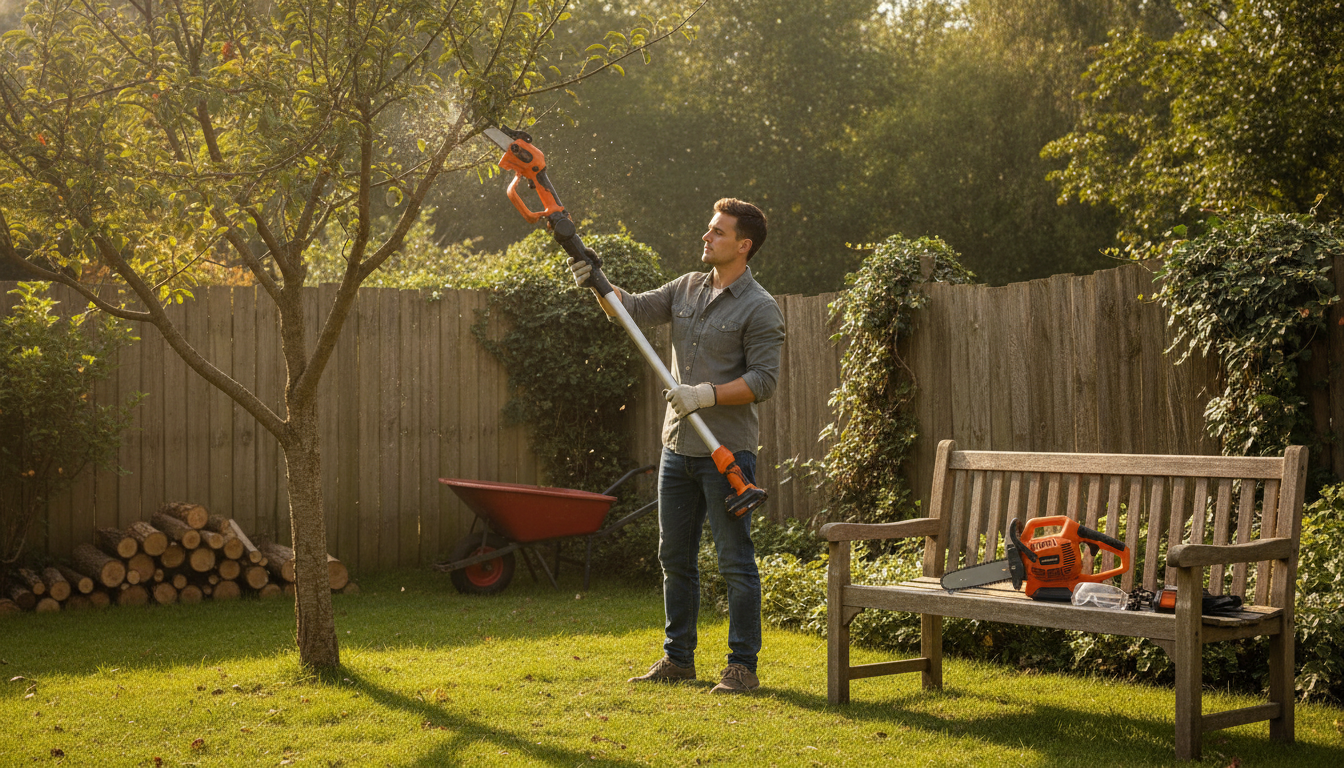
- Cordless pole saw chainsaw: a compact chainsaw head mounted on an extension pole so branches can be cut overhead from the ground, reducing ladder dependence.
- Battery-powered tree trimmer: a broad label that can include compact pruning saws, mini chainsaws, and powered loppers—tools designed for quick trimming and shaping within arm’s reach.
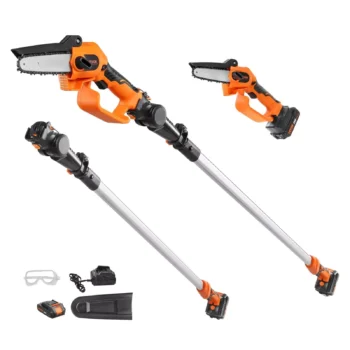
- 2-in-1 setups: some tools combine a handheld mini chainsaw with a pole attachment, aiming to cover both reach and close control while staying on one battery platform.
- Geometry matters: overhead limb removal benefits from pole reach and a chainsaw-style bite, while controlled pruning close to the body benefits from compact balance and precision.
Key Differences That Affect Results
Choosing between a pole saw chainsaw and a battery tree trimmer comes down to how the tool behaves when it meets wood—especially above shoulder height.
- Reach and leverage: pole tools add height, but the long lever amplifies torque. The head can feel “heavier” in motion than it does on a scale, which can increase fatigue.
- Cutting profile: chainsaw-style cutters generally do better when the limb is thicker or the bark is tougher; trimmer-style tools tend to favor fast, light cuts with more placement control.
- Maneuverability: handheld trimmers are easier to weave into dense canopies or between shrubs. Long poles can be awkward in tight spaces or near fences.
- Debris management: overhead cutting increases unpredictability—branches can swing, drop, or pin the bar. Cuts made at chest height are easier to control and predict.
- Typical branch size: pole saws often target small-to-medium limbs, while trimmers shine on small branches and routine maintenance.
Comparison Chart: Practical Buying Considerations
Use this chart to map typical yard tasks to the tool format that handles them with fewer compromises. If a tool advertises multiple modes (handheld + pole), make sure the switch is quick and that both configurations feel balanced during real cutting.
| Consideration | Cordless Pole Saw Chainsaw | Battery Powered Tree Trimmer |
|---|---|---|
| Best for | Overhead limb removal, clearing deadwood, storm cleanup | Routine pruning, shaping, small-branch trimming |
| Working height | High reach without ladder; overhead cuts common | Usually ground-level or step-up work; less overhead cutting |
| Typical branch thickness | Small to medium limbs; better bite on thicker wood | Small branches; precision over brute force |
| Control and fatigue | More fatigue due to leverage and overhead holding | Easier to control; less tiring for extended sessions |
| Safety considerations | Higher risk from falling limbs and overhead posture | Lower overhead risk; still requires eye/hand protection |
| Maintenance | Chain tensioning, bar oiling (if applicable), chain sharpening | Varies by design; often simpler, but still needs blade/chain upkeep |
| Ideal ownership profile | Occasional heavier cuts, taller trees, limited ladder use | Frequent light pruning and garden maintenance |
Power, Runtime, and What “20V” Really Means
Safety and Handling: Preventing the Common Mistakes
- Create a drop zone: keep bystanders and pets away, and stand to the side of the cut line rather than directly under the limb.
- Use an undercut/overcut approach: for larger branches, a small undercut first can reduce bark tearing, then finish with an overcut to complete the removal cleanly.
- Stability first: avoid ladders for chainsaw-head cutting when possible. A pole tool used from the ground is often safer than leaning and reaching.
- Wear the right PPE: eye protection and gloves are baseline; add hearing protection for longer sessions and a helmet when working under limbs.
- Watch for power lines: maintain safe clearance and stop if there’s any doubt. For guidance on recognized hazards, see OSHA’s Tree Care Operations and NIOSH guidance on preventing falls and electrocutions during tree trimming.
Maintenance and Long-Term Cost of Ownership
How to Choose Between a Pole Saw Chainsaw and a Battery Tree Trimmer
Typical Scenarios and the Best Fit
- After a storm: a pole saw chainsaw helps remove snapped limbs and clear overhead hazards (within safe limits and away from power lines).
- Seasonal pruning: a battery tree trimmer is well-suited for repeated shaping and cleanup where cuts are small and frequent.
- Fruit trees and ornamentals: trimmers often provide better precision and reduce accidental bark damage; use a pole saw when reach is truly necessary.
- Tall shade trees near structures: a pole saw may still be insufficient or unsafe. In complex cases, professional pruning may be the better option, aligned with recognized practices such as ANSI A300 tree care standards.
- One-tool households: a dual-mode design can cover most tasks if it remains comfortable both handheld and on the pole.
FAQ
Can a battery pole saw replace a regular chainsaw?
Not completely. A battery pole saw usually has a smaller bar and less cutting speed on thick hardwood, but it’s excellent for reach and for removing limbs overhead from the ground. For large trunks, repeated heavy cuts, or complex removals, a standard chainsaw or a certified pro is typically the better fit.
What branch size is too large for a cordless tree trimmer?
If the tool stalls repeatedly, vibrates excessively, or forces you to lean hard into the cut, the limb is likely beyond what that trimmer is meant to handle. Keeping the chain/blade sharp helps, but for thicker limbs it’s usually time to step up to a pole saw or a full-size chainsaw.
Is it safe to trim high branches without a ladder?
Using a pole tool from the ground is often safer than climbing because it reduces fall risk, but overhead cutting still requires a clear drop zone and strict avoidance of power lines. For very high branches, unstable limbs, or work near utilities, a certified arborist is the safer option.















Leave a comment
You must be logged in to post a comment.